
Water Safety for Dogs in Greater Victoria: Life Jackets, Currents & Knowing When to Say No
By Anna Hakim & Perry Fanthorpe, Happy Homes Team, eXp Realty | AI Certified Agents
Water Safety for Dogs in Greater Victoria:
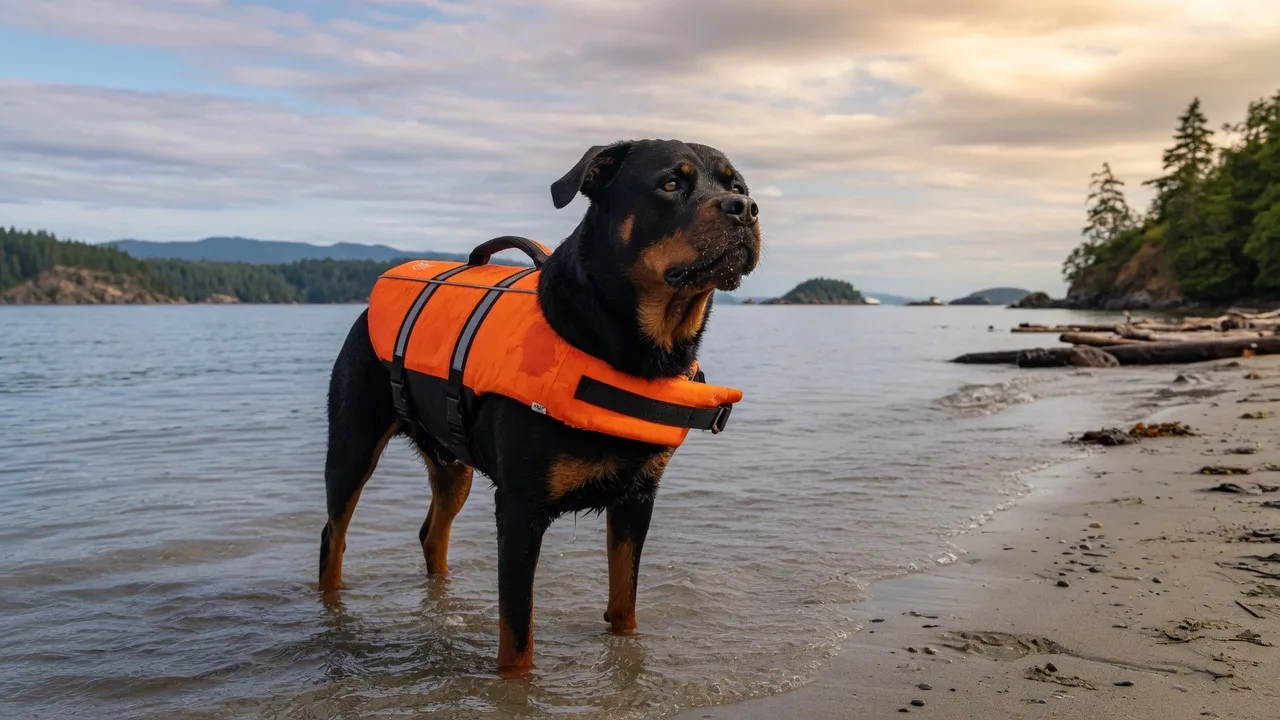
Ziggy loves the water the way some dogs love treats: completely, recklessly, and with no sense of self-preservation. Our 100-pound Rottweiler launches himself into Elk Lake like a cannonball, paddles furiously for 20 minutes, and would keep going until he literally could not lift his head if we let him. Sahara, our 13-year-old Lab mix, takes a different approach: she wades in up to her chest, stands there looking at us like she is considering her options, and then slowly walks back to shore. Two very different swimming styles, but one thing they both need: a human who knows when the water is safe and when it is not.
Greater Victoria is surrounded by water, and for dog owners, that is one of the best things about living here. But ocean currents, cold temperatures, blue-green algae, and simple exhaustion can turn a fun swim into an emergency fast. Here is what we have learned about keeping dogs safe in and around Victoria's lakes and beaches.
Do You Need a Dog Life Jacket? (Probably Yes)
The short answer is that every dog who swims in open water in Greater Victoria should wear a life jacket. Not because your dog cannot swim, but because conditions change faster than any dog can react to them. The Strait of Juan de Fuca stays cold year-round, ranging from about 8 degrees Celsius in winter to just 13 degrees in August. Cold water saps muscle strength fast. A dog who is a strong swimmer in a warm pool can lose coordination and start struggling after just a few minutes in Pacific waters.
A good life jacket does three things: it keeps your dog's head above water even when they are tired, it gives you a handle to lift them out of the water quickly, and it provides extra buoyancy that reduces the energy they need to stay afloat. For Sahara, who is older and slower, the life jacket is non-negotiable on any beach day. For Ziggy, who has the stamina of a freight train but zero judgement about his own limits, it is the difference between a fun afternoon and a trip to the emergency vet.
What to Look For in a Dog Life Jacket
- Dual grab handles. You need a handle on the back that lets you lift your dog straight out of the water. One handle is fine, two is better.
- Neck float support. A wrap-around flotation panel at the neck keeps the head above water even if the jacket shifts. Essential for dogs who might panic in the water.
- Secure adjustable straps. The jacket should fit snugly without restricting movement. Velcro alone is not enough, look for buckles and quick-release clips.
- Reflective elements. Low-visibility conditions happen faster than you expect on the water, especially if fog rolls in.
- Bright colour. Orange, yellow, or high-vis green makes your dog easy to spot against the water at a distance.
Brands like Ruffwear, Outward Hound, and Kurgo all make life jackets that meet these criteria. We use a Ruffwear K9 Float Coat for Sahara and an Outward Hound Granby Splash for Ziggy. Both have held up well through two seasons of heavy use.
Currents: What Every Dog Owner Needs to Know About Victoria's Waters
The ocean water around Victoria is not a swimming pool. The Strait of Juan de Fuca has some of the strongest tidal currents on the British Columbia coast, and those currents do not care how good a swimmer your dog is. The tide moves through the strait at several knots during peak flow, and a dog caught in an outgoing current can be pulled away from shore faster than you can react.
This matters most at exposed beaches like Dallas Road, Island View Beach, and the southern end of Willows Beach. On a calm day with a gentle tide, these spots are safe for supervised wading. On a day with a big tidal swing or after a storm that stirs up the water, keep your dog out entirely. The same goes for rip currents, which can form at any ocean-facing beach and pull even strong swimmers outward rapidly.
The simplest rule: if the water looks rough enough that you would hesitate to swim in it yourself, keep your dog out. Dogs do not make good decisions about currents. They will chase a stick or follow a scent without noticing that the water is pulling them away from shore. You are the one who has to notice.
Off-Leash Beach Supervision: Eyes on the Water at All Times
Victoria has several off-leash beach areas and on-leash beaches where dogs can access the water. The off-leash section at Dallas Road, Parker Park in Cordova Bay, and the designated dog beach at Elk Lake are the most popular spots. In every case, supervision means actually watching your dog in the water, not scrolling your phone on the beach while they swim.
Here is what we watch for when Ziggy and Sahara are in the water:
- Shivering. Even in August, ocean water is cold. If your dog starts shivering, they have been in too long. Get them out, dry them off, and let them warm up.
- Slowed paddling. A dog who was swimming strongly and suddenly looks like they are working harder to stay afloat is fatigued. Call them in immediately.
- Head dipping below the surface. If your dog is struggling to keep their head above water, do not wait to see if they recover. Go in and get them.
- Drifting sideways. If your dog is swimming but not making progress toward shore, they may be caught in a current. Move along the shore to a point where the angle is better and call them in.
- Panic behaviour. A dog who starts splashing frantically or making sounds of distress needs immediate help. Do not jump in after them if the water conditions are dangerous, extend a branch, a leash, or your arm from a stable position.
Freshwater Safety: Lakes, Algae, and the Current Situation
Freshwater lakes in Greater Victoria are generally safer for swimming than the ocean because there are no tides and no rip currents. But they come with their own set of risks, and the biggest one right now is blue-green algae.
Active Blue-Green Algae Advisories, July 2026
- Thetis Lake (main beach) — Active advisory as of July 15, 2026. Do not let your dog swim at the main beach area of Thetis Lake Regional Park.
- Prior Lake — Active advisory. Avoid all dog swimming.
- Beaver Lake — Active advisory. Avoid all dog swimming.
- Elk Lake — Advisory was lifted on May 20, 2026. Currently safe for swimming, but conditions can change quickly. Check the CRD website before every visit.
The Capital Regional District updates its algae advisories regularly. Bookmark the CRD alerts page and check it before every lake visit. If an advisory is posted, do not let your dog swim. Blue-green algae toxins can kill a dog within hours. There is no treatment and no antidote.
Even at lakes without active algae advisories, the same basic precautions apply: bring fresh water and a collapsible bowl so your dog is not tempted to drink from the lake, rinse your dog with fresh water after every swim, and do not let them eat or lick anything from the shoreline where algae might accumulate.
Cold Water Dangers You Might Not Think About
The Strait of Juan de Fuca and the lakes of Greater Victoria are cold. Even on a 30-degree day, the water temperature at Island View Beach will be around 12 degrees. That cold water causes two problems that are easy to miss:
- Cold water incapacitation. The shock of cold water can cause a dog to inhale water, lose coordination, and struggle to keep their head above the surface. This can happen in the first minute of entering cold water, even to a strong swimmer.
- Hypothermia after swimming. A dog who swims in cold water for more than 10 to 15 minutes can develop hypothermia even on a warm day. Wet fur loses insulation value, and the combination of cold water plus wind accelerates heat loss dramatically.
We limit Ziggy's swim sessions in the ocean to about 10 minutes, and we always carry a towel to dry him off immediately afterward. On cooler or windy days, we skip the ocean swim entirely and head to Elk Lake instead, where the water is warmer and there is less current to worry about.
A Simple Water Safety Checklist
Before Every Beach or Lake Visit
- Check the CRD website for active blue-green algae advisories at your destination lake.
- Check the tide tables for ocean beaches. Avoid beaches during outgoing tides when currents are strongest.
- Fit your dog's life jacket and check the straps fit snugly before you leave the car.
- Pack fresh water and a collapsible bowl. Your dog should not drink from the lake or ocean.
- Bring two towels: one for the initial rinse, one for drying off before the car ride.
- Bring a portable rinse jug (a 4-litre jug of fresh water) to rinse salt or lake water off your dog's coat before getting in the car.
- Know the nearest emergency vet clinic and have their number saved in your phone. For Greater Victoria, the 24-hour Animal Emergency Clinic of Victoria is at 120 Benvenuto Avenue.
Know Your Dog's Limits
Not every dog is built for open water, and that is completely fine. Sahara is a Lab mix, a breed famous for loving water, and she spends most beach days wading up to her belly and then standing there looking philosophical. She has never worn a life jacket and probably never will, because she stays in water she can stand in and comes out the moment she feels cold. Ziggy, on the other hand, has the endurance of a sled dog and the sense of a toddler. He wears his life jacket every time, and we set a timer on our phones for his swim sessions because he will not stop on his own.
The key is knowing which dog you have. Some breeds are natural swimmers: retrievers, spaniels, Newfoundlands, and standard poodles generally take to water easily. Others struggle: bulldogs, pugs, dachshunds, and dogs with heavy bodies and short legs are not built for swimming and should wear a life jacket whenever they are near water deeper than their chest. And even water-loving breeds can run into trouble in cold ocean water with currents they are not expecting.
If it is your dog's first time swimming in open water, start at a calm, shallow spot like the Elk Lake dog beach on a warm weekday. Walk into the water together and let your dog set the pace. Treat it like you would teach a kid to swim: short sessions, lots of praise, and always in water shallow enough that you can stand next to them. For senior dogs like Sahara, keep it even shorter and gentler. She much prefers a slow walk along the waterline to a swim, and honestly, so do we these days.
The Bottom Line
Water safety for dogs in Greater Victoria comes down to three things: a life jacket, a weather check, and paying attention. The life jacket gives your dog buoyancy and gives you a handle. The weather and tide check tells you whether conditions are safe. And paying attention, actually watching your dog in the water instead of assuming they are fine, is what prevents the emergencies that no amount of gear can fix.
Summer in Victoria is one of the best places in Canada to be a dog owner, and the water is a huge part of that. With the right preparation, every beach day and lake visit can be the kind of golden afternoon that becomes a core memory, for you and for your dog. That is what we are going for with Ziggy and Sahara every time we head to the water.
Stay safe out there, Victoria.
🐾